Newest FAQs
The typical fix to this issue is to buy a larger sleeve for the next imperial (inch) diameter up and duct tape the sleeve to the rod to fix it in place. A less-frequently used alternative is to buy a smaller sleeve and cut the sleeve to fit the anchor bolt. According to our customers... Read more
Not really. Plastic anchor sleeves are mass produced in standard sizes and are not feasible to be custom made with custom diameters or lengths. The tooling/molds to create a custom size are expensive and have long lead times to such a degree that the manufacturers of the sleeves are unwilling to pursue custom tooling. If a... Read more
According to the Incoterms 2010 standard which is published by the International Chamber of Commerce, the acronym “FOB” stands for “free on board.” In the US, this acronym “FOB” is commonly used when shipping goods to acknowledge who is responsible for the costs associated with loading, transporting and/or the point at which the ownership of... Read more
No. Just like in the case of anchor bolts being specified as A325, supplying anchor bolts as ASTM A490 is technically something that should be avoided. This is because the A490 specification is intended to cover heavy hex head bolts for structural steel connections only. This is mentioned in several places within the A490 specification.... Read more
Portland Bolt manufactures a wide range of bolts and fasteners to numerous standards set by many different organizations and specifying committees. There are many different organizations for fasteners, all of which have their own set of standards and guidelines for manufacturing. We, as estimators, are often asked what the acronyms for such organizations and committees... Read more
The grade of bolt used in a Slip Critical (SC) connection has no direct bearing on the connection itself, so the answer is yes. The SC connection means that it is a type of bolted structural steel connection which relies on friction between the two connected elements rather than bolt shear or bolt bearing to... Read more
The short answer is, yes! In 2015, ASTM created F3125 which is a new, all-inclusive specification for structural bolts that consolidated and replaced the following six stand-alone ASTM standards: A325, A325M, A490, A490M, F1852 and F2280. Under the new F3125 specification, A325 fasteners can be made in head styles other than heavy hex as long... Read more
Portland Bolt cannot manufacture a body bound type bolt. An example of a body bound or tight-fitting bolt is one in which precision is required in order to hold together parts of machinery or similar applications to prevent the slightest change of position of one part on another. This type of bolt must be supplied... Read more
There is no mention of any ASTM A615 grade being specifically used for anchor bolts in any ACI, AISC or ASTM specifications that we are aware of. Simply, the A615 grade is a rebar specification for concrete reinforcement; it is not an anchor bolt or raw steel specification. Using rebar for anchor bolts does present... Read more
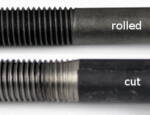
When threading bolts, the two most commonly used methods are cut threading and roll threading. We are often asked if bolts which have been roll threaded have a full body diameter or a reduced body diameter. Depending on the type of fastener, the answer is both. When Portland Bolt produces bolts with rolled threads, we... Read more