Timber Bolts
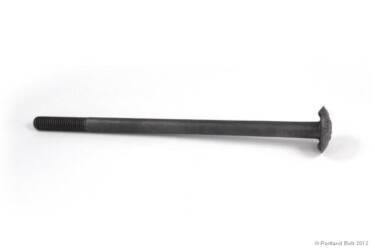
Timber bolts are also referred to as dome head, fender head, safety head, and mushroom head bolts. In the Pacific Northwest, they are referred to as economy bolts. Portland Bolt manufactures timber bolts from 1/2″ diameter through 1-1/2″ diameter in most ASTM, AASHTO, and SAE specifications. Special timber bolt tooling can be created to produce nonstandard head dimensions or bolt heads with your company’s name and/or logo.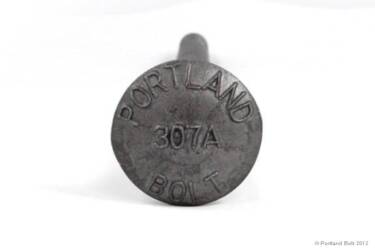
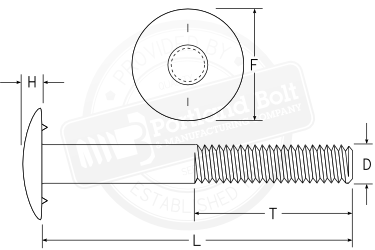
Applications
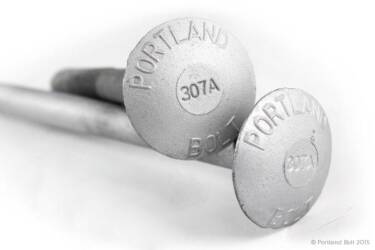
Timber bolts are used in marine and wood applications. The underside of the large, rounded, low-profile head of a timber bolt has two nubs or fins that prevent the bolt from turning in the timber while the nut is assembled. The oversized timber bolt head eliminates the need for a malleable iron washer and, therefore, reduces costs.
Specs
Thread Length
Most stock timber bolts have 4″ to 8″ of thread depending on length.
Timber Bolt Dimensions
| Bolt Diameter | D | F | H |
|---|---|---|---|
| Body Diameter Max | Head Diameter | Head Height | |
| 1⁄2 | 0.515 | 11⁄2 | 1⁄4 |
| 5⁄8 | 0.642 | 115⁄16 | 5⁄16 |
| 3⁄4 | 0.768 | 21⁄4 | 3⁄8 |
| 7⁄8 | 0.895 | 25⁄8 | 7⁄16 |
| 1 | 1.022 | 27⁄8 | 1⁄2 |
| 11⁄8 | 1.149 | 27⁄8 | 1⁄2 |
| 11⁄4 | 1.277 | 27⁄8 | 1⁄2 |
| 13⁄8 | 1.404 | 3 | 3⁄8 |
| 11⁄2 | 1.531 | 3 | 3⁄8 |
Stock List
Diameters: 3/4″, Lengths: 8″ – 36″ in 2″ increments
Stock Timber Bolts
| 3/4" Dia. Galv | |
|---|---|
| Length | Part # |
| 8 | 18549 |
| 10 | 18553 |
| 12 | 18557 |
| 14 | 18561 |
| 16 | 18565 |
| 18 | 18569 |
| 20 | 18573 |
| 22 | 18577 |
| 24 | 18581 |
| 26 | 18583 |
| 28 | 18585 |
| 30 | 18587 |
| 32 | 18589 |
| 36 | 18595 |
| Other sizes and finishes made to order | |
FAQs
A timber bolt, also known as a dome head, fender head, safety head, mushroom head, or economy bolt, is a large, round-headed fastener designed for wood and marine applications. The underside of its low-profile, dome-shaped head includes two small nubs or fins that bite into the wood to prevent the bolt from turning during installation. This built-in locking feature eliminates the need for a washer under the head, making timber bolts both economical and efficient for heavy timber construction.
Timber bolts are most commonly used in wood-to-wood and wood-to-steel connections across industries such as construction, marine, and infrastructure. They are frequently specified in dock and pier construction, timber bridges, boardwalks, fender systems, and retaining structures. In marine environments, the rounded, low-profile head provides a safer surface than a hex head bolt, reducing the risk of injury or vessel damage in areas of contact. In the Pacific Northwest, these bolts are often referred to as economy bolts due to their cost-saving design that eliminates the need for separate washers.
The defining features of a timber bolt are its oversized, dome-shaped head and the two nubs or fins forged beneath it. These nubs grip into the wood to prevent rotation while tightening the nut on the threaded end, allowing for efficient installation without requiring a wrench on the head. Because the nubs must embed into a wood surface, timber bolts are not used with washers under the head, nor are they suitable for installation directly against steel unless specifically manufactured without nubs. This combination of design elements makes timber bolts both functional and visually unobtrusive in exposed wood applications.
Portland Bolt manufactures timber bolts from 1/2″ through 1-1/2″″ in diameter in most ASTM, AASHTO, and SAE specifications. Commonly produced grades include ASTM A307 Grade A for mild steel applications and A449 for high-strength applications, though other grades can be provided upon request.
Standard stock timber bolts include:
- Grade: ASTM A307, ASTM A449
- Diameter: 3/4″
- Lengths: 8″ to 36″ (in 2″ increments)
- Finish: Hot-dip galvanized
- Origin: Domestic
Custom orders can be manufactured in additional diameters, with nonstandard head sizes, with specific thread lengths, or with custom head markings such as company logos.
Stock thread lengths typically follow this pattern:
- Bolts ≤ 12″: 4″ of thread
- Bolts 14″–16″: 6″ of thread
- Bolts ≥ 18″: 8″ of thread
For longer or specialized timber bolts, custom thread lengths can be manufactured to meet project-specific requirements.
No. Timber bolts do not require a washer beneath the head. The large, rounded head provides sufficient bearing surface, and the nubs under the head are designed to bite directly into the wood. Using a washer under the head would prevent these nubs from engaging and eliminate their anti-rotation function. In addition to cost savings, this design improves installation efficiency by removing the need for an extra component such as a malleable iron or ogee washer.
The nubs under a timber bolt’s head are integral to its function. They are small raised projections forged into the underside of the head during manufacturing. When installed into wood, the nubs dig in and prevent the bolt head from turning while the nut is tightened from the opposite end. This feature allows a single installer to tighten the assembly without requiring a tool to hold the bolt head in place. Because the nubs rely on wood penetration, timber bolts with standard nubs should not bear directly against steel surfaces. Often, high-strength A449 timber bolts are used to fasten steel to wood. In these cases, the nubs are often eliminated from the underside of the bolt head when it is in contact with steel.
Standard timber bolts are not recommended for steel-to-steel applications because the forged nubs beneath the head are designed to embed into wood, not metal. However, Portland Bolt can custom-manufacture timber bolts without nubs for use where the bolt head bears on steel. When placing an order, customers should specify that the bolt head is to bear on steel so the manufacturing team can omit the nubs during the hot-forging process. This modification ensures proper seating and torque transfer without damaging the bearing surface.
Timber bolts are typically manufactured from low-carbon steel in compliance with ASTM A307 and supplied with a hot-dip galvanized finish for corrosion protection. Portland Bolt performs all galvanizing in-house, ensuring fast turnaround and consistent coating quality. Custom orders can be supplied in A449, plain finish, zinc-plated, or stainless steel (Type 304 or 316) depending on environmental and design requirements.
Portland Bolt manufactures timber bolts through an in-house hot-forging process that ensures structural strength and dimensional consistency. The process includes:
- Cutting: Steel round bar is cut to the required bolt length.
- Heading: The end of the bar is heated and forged into a dome head, forming the characteristic rounded profile and embedding the anti-rotation nubs beneath the head.
- Threading: Threads are cut or rolled to ASME specifications.
- Finishing: Bolts are hot-dip galvanized for corrosion resistance or left plain as specified.
This vertically integrated manufacturing process ensures dimensional accuracy, consistency, and full domestic traceability.
Timber drive spikes are large, heavy-duty fasteners that resemble nails more than bolts. They are designed to be driven directly into wood rather than tightened with a nut. Unlike timber bolts, drive spikes feature fettered lag threads and do not require the nubs beneath the head, since there is no nut assembly that could cause the head to rotate. Timber drive spikes are ideal for joining wood members where high withdrawal resistance is needed without through-bolting, such as in rail ties, retaining structures, and large wooden beams.
Yes. Portland Bolt can manufacture custom timber bolts to accommodate unique specifications, including:
- Nonstandard head dimensions or profiles
- Omission of nubs for steel-bearing applications
- Extended or modified thread lengths
- Custom head markings or logo embossing
- Large diameters up to 1-1/2″ diameter
Custom tooling can also be developed with a company and logo or to match historical restoration requirements, ensuring both aesthetic consistency and functional performance.
Timber bolts are particularly well-suited for marine, boardwalk, and pedestrian environments because of their rounded, low-profile head. This design minimizes snag hazards and impact damage, providing a safer, smoother surface if people or vessels come into contact with the fastener. Combined with a hot-dip galvanized coating for corrosion protection, timber bolts provide long-lasting durability and safety in high-traffic or wet environments.
PRODUCT USED IN
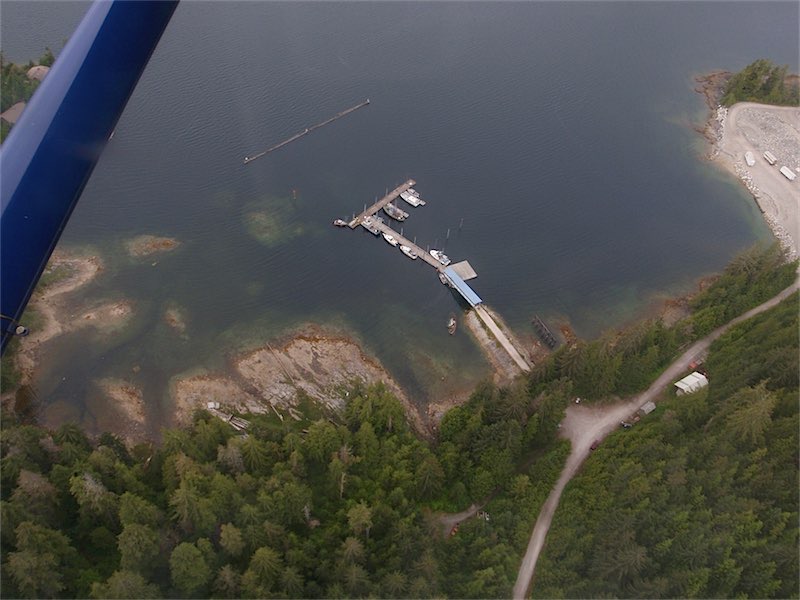
Edna Bay Harbor Improvements
Edna Bay, which is the only populated town on the remote Kosciusko Island in southeastern Alaska, relies heavily on the fishing industry for their local economy. In 2020, the boat harbor in Edna Bay needed upgrades. The project required the removal and replacement of the timber float system in the Edna Bay small boat harbor facility. Portland Bolt was selected to provide the hardware for the project. The materials consisted primarily of headed bolts, such as hex bolts, lag bolts, and timber bolts as long as 44”. Our roll threading equipment enables these custom bolts to be manufactured extremely efficiently.... View More