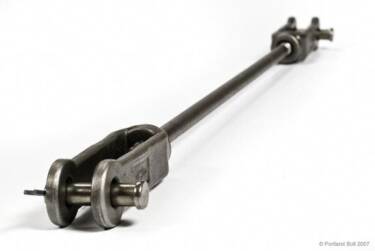
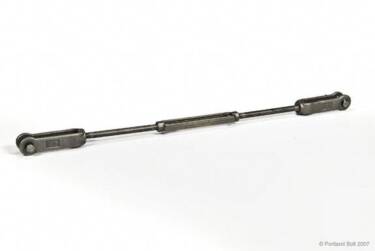




A tie rod assembly is used to brace steel columns or heavy timber beams or used to support canopies and awnings. Tie rods are often used with clevises and/or turnbuckles. Our Tie Rod Calculator will quickly determine rod lengths when given overall pin-to-pin dimensions of a tie rod assembly.
Manufacturing
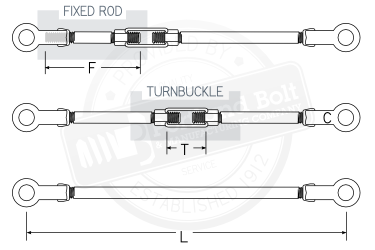
Portland Bolt manufactures tie rod or sag rod assemblies in many different ASTM specifications. Two common configurations of tie rod assemblies are used. One configuration consists of a single rod with left-hand thread on one end and right-hand thread on the other end. A clevis is threaded onto each end of the rod and the assembly is drawn tight by turning the rod. The second configuration of tie rod assembly consists of two rods with a turnbuckle in the middle and clevises on each end. For this assembly, one rod is threaded right hand/right hand while the other rod is threaded right hand/left hand. A turnbuckle is assembled between the two rods and the assembly is drawn tight by rotating the turnbuckle. Occasionally, tie rod assemblies are connected using sleeve nuts or coupling nuts.
Tie rods are commonly manufactured using low carbon steel, but higher strength assemblies can be manufactured. Carbon or alloy steel tie rod assemblies can be supplied either plain finish or hot-dip galvanized, and stainless steel tie rod assemblies are common as well. Portland Bolt estimators can assist in determining the correct rod length. Complete tie rod packages are assembled in our facility to ensure accurate thread fit before shipping to your job site.
FAQs
A tie rod assembly is a tension system used to brace steel columns, support canopies, stabilize beams, or reinforce heavy timber structures. It typically consists of threaded steel rods, clevises, and turnbuckles that connect to provide adjustable tension between structural points.
Tie rods, also referred to as sag rods or tension rods, are common in applications such as awnings, bridge bracing, roof trusses, and facade support systems.
Portland Bolt manufactures tie rods in two standard configurations:
- Single-Rod Configuration:
A single rod is threaded left-hand on one end and right-hand on the other, with a clevis attached to each end. Tension is applied by rotating the rod itself. - Double-Rod Configuration:
Two rods are used, connected by a turnbuckle in the center and clevises on both ends. One rod is right-hand/right-hand, and the other is right-hand/left-hand, allowing for easy adjustment by turning the central turnbuckle.
Both configurations may use sleeve nuts or coupling nuts as alternative connectors for specific design requirements.
Portland Bolt manufactures tie rods in a variety of materials and finishes to meet project specifications:
- Materials: Low carbon steel (A36 or A307A) is standard; higher-strength options such as A449, A572 Grade 50, or A354 are available for engineered applications.
- Stainless Steel: Type 304 or 316 stainless steel rods, with electropolished Type 316 clevises and turnbuckles.
Finishes: Available plain, hot-dip galvanized, or stainless.
All cutting, threading, fabrication, assembly, and galvanizing are completed in-house to ensure accurate fit and short lead times.
Each assembly is custom manufactured and test-fitted prior to shipment.
Processes include:
- Cutting and threading to close tolerances
- Assembly and test-fitting with clevises and turnbuckles
Hot-dip galvanizing (ASTM F2329) or electropolishing (for stainless)
This ensures proper thread engagement and alignment, minimizing field adjustments.
Portland Bolt’s Tie Rod Calculator determines rod lengths based on the overall pin-to-pin (P2P) dimension of your assembly. It accounts for clevis size, grip, and turnbuckle type, removing guesswork from the design process.
The tool can calculate rod lengths for:
- Single clevis-to-clevis rods
- Double-rod assemblies with centered turnbuckles
- Fixed-length assemblies
It also identifies the correct clevis number based on rod diameter and pin size.
Access the tool here: Tie Rod Calculator
To ensure accurate manufacturing, please include the following when requesting a quote:
- Configuration:
- Single rod (left/right-hand threads)
- Double rod with centered turnbuckle
- Double rod with offset turnbuckle
- Rod Diameter:
Determines compatible clevis and turnbuckle sizes. (Example: ⅞″ rods may use #2½ or #3 clevises.) - Overall Length (Pin-to-Pin):
Distance between the centerlines of both clevis pins. - Clevis Pin Size:
Based on rod diameter and clevis number; ensures proper strength and fit. - Clevis Grip:
The plate thickness plus ¼″, defining the distance between clevis ears. - Finish:
Specify plain, hot-dip galvanized, or stainless finish. - Quantity:
Indicate total assemblies per configuration and size. - Material Grade:
Commonly A36 or A307A. High-strength grades such as A572 Grade 50 or A449 are available upon request.
Portland Bolt’s experienced estimators will confirm all necessary details to guarantee compatibility and smooth assembly.
Most tie rods are made from mild carbon steel conforming to ASTM A36 or A307A.
For higher-strength designs, engineers may specify A572 Grade 50, A449, or A354.
When using these stronger grades, reinforced clevises or turnbuckles may be required to match the rod’s tensile capacity. Portland Bolt can provide guidance and special-order high-strength fittings when needed.
Yes. Portland Bolt’s engineering team and online Tie Rod Calculator can determine:
- Required rod lengths based on pin-to-pin dimensions
- Clevis number and pin size selection
- Appropriate thread engagement and turnbuckle take-up
Complete tie rod packages are assembled in-house to ensure proper fit and function prior to shipment.
If project drawings lack certain details (e.g., grip, pin size, or exact thread length), Portland Bolt can provide an estimate for bidding purposes and mark values as “To Be Determined.” However, all specifications must be verified and approved by the engineer of record prior to production.
Yes. Portland Bolt provides fully assembled tie rod systems that include:
- Threaded rods
- Clevises and pins
- Turnbuckles (if required)
- Nuts, washers, and hardware
- Finishing (galvanized or stainless)
Each assembly is test-fitted before shipping to ensure smooth installation and proper adjustment in the field.