
Hex Lag Screw
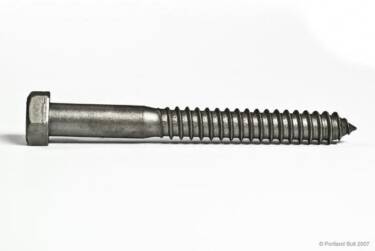
Hex lag screws are large wood screws designed for fastening into wood by rotating the six-sided head. Although often referred to as “lag bolts,” they are technically screws because they are not used with a nut. Their deeper, sharper lag thread is designed to drive into wood, unlike national coarse thread. Imported hex lag screws typically originate from Asia, include a gimlet point, and meet ASTM A307 Grade A requirements. Portland Bolt manufactures lag screws from 1/2″ diameter through 1-1/2″ diameter in most ASTM, AASHTO, and SAE specifications, including domestic lag screws, nonstandard head dimensions, and custom heads with a company name or logo when required.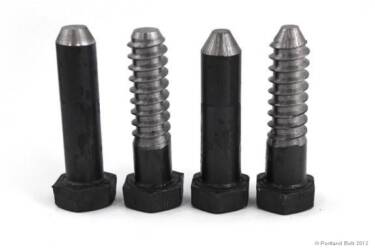


Applications
Hex lag screws are used in wood fastening applications where a large-diameter screw is needed to create a strong connection. For nonstandard lag screws manufactured by Portland Bolt, a semi-cone point is typically used unless otherwise specified. A full gimlet or cone point is generally unnecessary for larger lag screws because installation requires a pilot hole drilled nearly as large as the root diameter of the screw. Without a pilot hole, the torque required to install large lag screws can cause the heads to break before the screw is properly seated.
A common nonstandard application is radial reinforcement of glulam beams. Portland Bolt manufactures fully threaded lag screws, sometimes called “stitch bolts,” that are often several feet long and used to help prevent the laminations of glued laminated beams from separating over time.
Specs
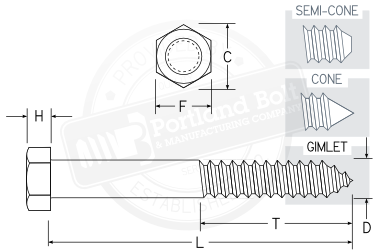
The minimum thread length shall be equal to one-half the nominal screw length plus 1/2″ or 6”, whichever is less. One may consider longer than standard thread lengths for lag screws, which are extremely long.
Note: Hex lag screws larger than 3/4″ in diameter and most square lag screws are rarely available as stock items in the marketplace.
Hex Lag Dimensions
| Bolt Diameter | D | F | H | Threads Per Inch | Thread Dimension | ||||
|---|---|---|---|---|---|---|---|---|---|
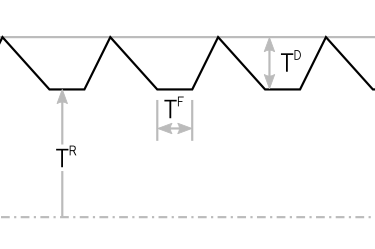
| Body Diameter | Width Across Flats | Head Height | Pitch | TF | TD | TR | |||
| Max | Min | Flat At Root | Depth of Thread | Root Diameter | |||||
| 1⁄2 | 0.515 | 0.482 | 3⁄4 | 11⁄32 | 6 | 0.167 | 0.072 | 0.064 | 0.371 |
| 5⁄8 | 0.642 | 0.605 | 15⁄16 | 27⁄64 | 5 | 0.200 | 0.086 | 0.077 | 0.471 |
| 3⁄4 | 0.768 | 0.729 | 11⁄8 | 1⁄2 | 41⁄2 | 0.222 | 0.096 | 0.085 | 0.579 |
| 7⁄8 | 0.895 | 0.852 | 15⁄16 | 37⁄64 | 4 | 0.250 | 0.108 | 0.096 | 0.683 |
| 1 | 1.022 | 0.976 | 11⁄2 | 43⁄64 | 31⁄2 | 0.286 | 0.123 | 0.110 | 0.780 |
| 11⁄8 | 1.149 | 1.098 | 111⁄16 | 3⁄4 | 31⁄4 | 0.308 | 0.133 | 0.119 | 0.887 |
| 11⁄4 | 1.277 | 1.223 | 17⁄8 | 27⁄32 | 31⁄4 | 0.308 | 0.133 | 0.119 | 1.012 |
| 13⁄8 | 1.404 | 1.346 | 21⁄16 | 29⁄32 | 3* | 0.333 | 0.143 | 0.128 | 1.119 |
| 11⁄2 | 1.531 | 1.469 | 21⁄4 | 1 | 3* | 0.333 | 0.143 | 0.128 | 1.244 |
| Dimensions per ASME B18.2.1 1996 * ASME only provides dimensional data for lag screws through 1¼” diameter. Lag screws over 1¼” diameter use custom thread pitches. | |||||||||
Stock List
Diameters: 1/2″ – 1″, Lengths: 18″ maximum, ASTM A307 Grade A
Stock Lag Screws
| Length (in.) | Diameter | |||||||||
|---|---|---|---|---|---|---|---|---|---|---|
| 3/8" | 1/2" | 5/8" | 3/4" | 1" | ||||||
| Plain | Galv. | Plain | Galv. | Plain | Galv. | Plain | Galv. | Plain | Galv. | |
| 1 | 11375 | 11376 | - | - | - | - | - | - | - | - |
| 11⁄4 | 11377 | 11378 | - | - | - | - | - | - | - | - |
| 11⁄2 | 11379 | 11380 | 18904 | 18905 | - | - | - | - | - | - |
| 13⁄4 | 11381 | 11382 | - | - | - | - | - | - | - | - |
| 2 | 11383 | 11384 | 11413 | 11414 | 11447 | 11448 | - | - | - | - |
| 21⁄2 | 11385 | 11386 | 11415 | 11416 | 11449 | 11450 | - | 19575 | - | - |
| 3 | 11387 | 11388 | 11417 | 11418 | 11453 | 11454 | 11489 | 11490 | - | - |
| 31⁄2 | 11389 | 11390 | 11419 | 11420 | 11455 | 11456 | 11491 | 11492 | - | - |
| 4 | 11391 | 11392 | 11421 | 11422 | 11457 | 11458 | 11493 | 11494 | - | - |
| 41⁄2 | 11393 | 11394 | 11423 | 11424 | 11459 | 11460 | - | - | - | - |
| 5 | 11395 | 11396 | 11425 | 11426 | 11461 | 11462 | 11497 | 11498 | - | - |
| 51⁄2 | 11397 | 11398 | 18906 | 18907 | 18908 | 18909 | - | - | - | - |
| 6 | 11399 | 11400 | 11429 | 11430 | 11465 | 11466 | 11501 | 11502 | - | - |
| 7 | 11403 | 11404 | 11433 | 11434 | 11469 | 11470 | 11505 | 11506 | - | - |
| 8 | 11407 | 11408 | 11437 | 11438 | 11471 | 11472 | 11509 | 11510 | - | - |
| 9 | - | - | 11439 | 11440 | 11473 | 11474 | 11511 | 11512 | - | - |
| 10 | 11411 | 11412 | 11441 | 11442 | 11475 | 11476 | 11513 | 11514 | - | - |
| 11 | - | - | - | - | 18910 | 18911 | 18913 | 18914 | - | - |
| 12 | 18902 | 18903 | 11445 | 11446 | 11479 | 11480 | 11517 | 11518 | - | 17140 |
| 14 | - | - | 18266 | 18267 | 11481 | 11482 | 11521 | 11522 | - | - |
| 16 | - | - | 18268 | 18269 | 19597 | 19545 | 11525 | 11526 | - | - |
| 18 | - | - | 18270 | 18271 | 19693 | 19694 | 11529 | 11530 | - | - |
| 20 | - | - | - | - | - | - | 18915 | 18916 | - | - |
| These sizes are readily available in the marketplace and Portland Bolt stocks many of them in varying quantities. If you require a size that is not listed, Portland Bolt will manufacture them. | ||||||||||
FAQs
A hex lag screw, often referred to as a lag bolt, is a large wood screw with a hexagonal head designed to be driven directly into wood. Although the term “lag bolt” is commonly used, it is technically a screw, not a bolt, since it does not use a nut.
The lag thread is deeper and sharper than a standard national coarse thread, enabling it to cut into wood and form a secure connection. Lag screws are used in heavy timber, structural framing, and outdoor applications where strong, direct fastening to wood is required.
Lag screws are primarily used for connecting wood-to-wood or wood-to-steel components in structural and construction applications. Common uses include:
- Securing timber framing and beams
- Fastening deck supports and bridge timbers
- Anchoring equipment or railings to wood bases
- Reinforcing glulam beams with long, fully threaded “stitch bolts” that prevent lamination separation
Their deep thread design allows them to achieve high withdrawal resistance and strong holding power in heavy timber or dimensional lumber.
While the terms are often used interchangeably, the distinction is important:
- A bolt is designed to be used with a nut, relying on clamping force to hold materials together.
- A lag screw is a self-tapping fastener driven directly into wood without a nut.
Lag screws are rotated by the head, not by tightening a nut. For this reason, they are considered screws, not bolts, even though their heads resemble hex bolts.
Portland Bolt manufactures hex lag screws from ½″ through 1½″ in diameter and in virtually any length.
Stock sizes include:
- Diameters: ½″ – 1″
- Length: Up to 18″ (imported)
- Grade: ASTM A307 Grade A (mild steel)
- Finish: Plain or hot-dip galvanized
- Origin: Import and domestic
Custom-manufactured lag screws can meet other ASTM, AASHTO, and SAE specifications as required by project drawings.
Lag screws are typically made from low-strength carbon steel per ASTM A307 Grade A, but can also be produced in higher-strength grades (e.g., A449, A354, and SAE J429) or in stainless steel when specified.
Finishing options include:
- Plain steel – for general interior use
- Hot-dip galvanized – for corrosion resistance in outdoor or marine environments
- Stainless steel – for architectural or high-moisture conditions
Portland Bolt performs galvanizing in-house, ensuring fast turnaround and consistent coating quality.
Lag screws are available with either hex heads or square heads.
- Hex heads are standard and offer a clean, modern appearance with efficient torque transfer.
- Square heads are used primarily for aesthetic or restoration purposes, providing a rustic or historical look consistent with early construction methods.
Both head styles share the same mechanical strength and installation characteristics.
There are three primary point types used for lag screws:
- Cone point – sharp taper, used in smaller fasteners
- Semi-cone point – standard for Portland Bolt’s lag screws; aids alignment into a pilot hole
- Gimlet point – sharp, self-drilling tip used on small-diameter screws only
Larger-diameter lag screws (½″ and above) use semi-cone points since they require pilot holes for installation. Gimlet points are unnecessary for these sizes and would demand excessive torque.
Pilot holes are pre-drilled openings that allow lag screws to be installed without splitting the wood or breaking the screw head under torque.
For large-diameter lags, the pilot hole diameter should be slightly smaller than the screw’s root diameter to maintain thread engagement while minimizing driving resistance.
Engineers typically determine pilot hole size based on wood species, screw diameter, and load requirements.
The minimum thread length is defined as:
Half of the nominal screw length + ½″, or 6″, whichever is less.
For example, a 10″ lag screw would have:
(10 ÷ 2) + 0.5 = 5½″ of thread.
Longer lag screws or those used for specific engineered applications may require custom thread lengths beyond this standard.
Yes. Portland Bolt can produce custom lag screws with:
- Nonstandard diameters or lengths
- Fully threaded “stitch bolts” for glulam reinforcement
- Custom head markings (company name or logo)
- Nonstandard head dimensions
- Alternative steel grades or finishes
All manufacturing, including cutting, heading, threading, pointing, and galvanizing, is performed in-house for complete quality control.
Lag screws are produced through a controlled, multi-step process:
- Cutting:
20′ steel round bars are cut to the required length, either sheared or saw-cut for clean, repeatable cuts. - Heading:
The steel end is heated and hot-forged using an upsetter to form the hex or square head. This step also applies head markings. - Pointing:
A semi-cone point is used to aid pilot-hole insertion. - Threading:
Threads are cut (not rolled) using specialized chasers to form deep lag threads suitable for wood. - Galvanizing (if required):
Bolts are hot-dip galvanized for long-term corrosion resistance.
Each stage is performed domestically and in-house, ensuring full control of quality and lead times.
A gimlet point is a sharp, self-drilling tip commonly used on small-diameter lag screws that can be installed without a pilot hole.
However, gimlet points are not recommended for large-diameter screws because the torque required for installation would likely shear the head or split the wood. Portland Bolt uses semi-cone points instead for safety and reliability.
Standard stock includes ½″ to 1″ diameters up to 18″ or 20″ long, typically imported and supplied with gimlet points.
Lag screws larger than ¾″ in diameter, and square-headed lags are rarely stocked in the marketplace but can be custom-manufactured domestically upon request.
When ordering lag screws, always confirm the following:
- Diameter and overall length (measured from under the head)
- Grade and specification (ASTM A307A unless otherwise specified)
- Head type (hex or square)
- Finish (plain, galvanized, or stainless)
- Thread length and point type (standard semi-cone)
- Origin requirement (domestic or import)
Providing these details ensures accurate manufacturing and compliance with your project’s engineering specifications.
Portland Bolt manufactures fully threaded lag screws used for radial reinforcement of glulam beams, often several feet long. These “stitch bolts” prevent separation of laminations over time and are produced to tight thread and dimensional tolerances for long-term performance.
PRODUCT USED IN
Scorpion Pier
Located on Santa Cruz Island in Channel Islands National Park, Scorpion Pier welcomes more than 55,000 visitors each year. When the aging pier required replacement, Portland Bolt supplied over 7,500 hot-dip galvanized hex lag screws manufactured in the United States. The fasteners met National Park Service domestic steel requirements while supporting construction at the remote island job site. Portland Bolt’s in-house forging and galvanizing capabilities helped meet the project’s needs.