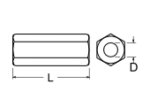
Newest FAQs
High-strength clevises can be provided in instances where smaller clevises are needed while keeping a higher safe working load. High-strength clevises are also used to develop the full capacity of high-strength threaded rods. Since high-strength clevises are not readily available in the marketplace, these items can add significant lead time and cost to the assembly.... Read more
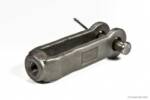
A turnbuckle body is designated by the diameter of the rod threading into it and the length of the take-up inside the turnbuckle rather than the overall length. For example, a 1” x 6” turnbuckle body has an overall length of 8⅞”, but has an opening or “window” measuring 6”. Common sizes available are 6”,... Read more
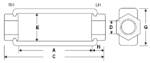
Unless instructed otherwise, Portland Bolt will ship nuts and washers unassembled from bolts, with a few exceptions: Tie Rod Assemblies Tie rod assemblies are commonly used in heavy timber construction and in erecting architectural and structural steel. The assemblies typically consist of a threaded rod with right hand thread on one end and left hand... Read more
The thread runout portion of a bolt is where the threaded section transitions into the bolt shank. This area exists beyond where the usable thread stops. In other words, if you were to assemble a nut all the way onto a bolt, the nut will stop, but there will still be a small portion of... Read more
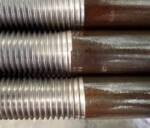
Yes. Per the RCSC Specification for Structural Joints Using High-Strength Bolts (2014), section 8.2, it says: “When it is impractical to turn the nut, pretensioning by turning the bolt head is permitted while the rotation of the nut is prevented, provided that the washer requirements in Section 6.2 are met”
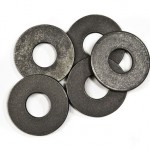
If a purchaser specifies an ASTM F844 washer with the dimensions of Portland Bolt’s plate washers, then the washers do meet the requirements of F844. According to ASTM F844, a specification for general use steel washers, the washer dimensions must conform to ASME B18.21.1, Type A, Tables 1A and Tables 1B, unless otherwise specified. The... Read more
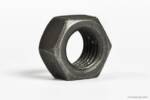
A standard hex nut, also referred to as a finished hex nut, has a smaller width across the flats and corners compared to a heavy hex nut, and a heavy hex nut is slightly thicker than a standard hex nut of the same nominal size. In fact, heavy hex nuts are exactly a 1/8” larger... Read more
The United States Rural Utilities Service (RUS) is in charge of administering programs that provide rural communities with infrastructure or infrastructure improvements. The programs administered by the RUS include water and waste treatment, electric power, and telecommunications services. The RUS is a part of the USDA Rural Development Agency of the United States Department of Agriculture. The RUS provides assistance... Read more
Although ASME B18.2.1 allows for reduced body diameter bolts (where the unthreaded shank is equal to the pitch diameter of the threads), the American Wood Council does not. In Section 13.1.3.3 of the 2015 National Design Specification for Wood Construction, it says: “Bolts used with split ring and shear plate connectors… shall have an unreduced... Read more
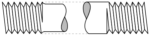
Hex and heavy hex coupling nuts can be made in custom lengths. Depending on the size and grade, however, there may be an extended lead time associated with doing that. Off-the-shelf coupling nut lengths have fairly few options for a given diameter. As long as the coupling nut is long enough to achieve the desired thread... Read more