
Newest FAQs
Although ASME B18.2.1 allows for reduced body diameter bolts (where the unthreaded shank is equal to the pitch diameter of the threads), the American Wood Council does not. In Section 13.1.3.3 of the 2015 National Design Specification for Wood Construction, it says: “Bolts used with split ring and shear plate connectors… shall have an unreduced... Read more
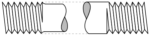
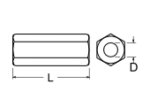
Hex and heavy hex coupling nuts can be made in custom lengths. Depending on the size and grade, however, there may be an extended lead time associated with doing that. Off-the-shelf coupling nut lengths have fairly few options for a given diameter. As long as the coupling nut is long enough to achieve the desired thread... Read more
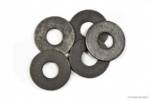
In general substituting one grade of fastener for another is a bad idea, as that substitution can open you up to liability concerns, but does this apply to washers? ASTM F844 covers standard, unhardened steel washers for general use. ASTM F436 covers hardened steel washers used with most high strength bolts and F1554 anchor bolts. F844 is... Read more
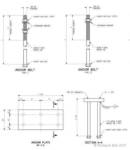
A36M55 is an outdated call out for anchor bolts primarily used by the light pole and traffic signal industries. It was used to specify ASTM A36 steel (36 ksi yield strength) that had been chemically modified to develop a minimum 55 ksi yield strength. In 1994 the F1554 specification was introduced, and F1554 Grade 55... Read more

A takeoff is a list of all the materials required to build a project based on the supplied plans. For example, if you had plans for building a dock, the plans might show a typical section of dock and you would use that to extrapolate how many board feet of timber and how many bolts... Read more
From time to time our friendly estimators may mention that we are going to make your order using bolt blanks. But what is a bolt blank? In order to help facilitate small runs of custom bolts and rush orders, Portland Bolt stocks bolt blanks. Bolt blanks are headed bolts that have not been threaded yet.... Read more
The concern with galvanizing any high strength steel is the risk of hydrogen embrittlement. There is plenty of research on galvanizing high strength steels, but conclusions vary on the strength at which hydrogen embrittlement will likely occur when the parts are galvanized. Some research identifies 150 ksi tensile strength as a threshold, but other research... Read more
The turn of the nut method is a very popular and reasonably reliable method for tensioning (F3125) A325 and A490 structural bolts without the need for expensive torque wrenches or tension measuring devices. It is a simple guide that tells the user to rotate the nut a specified amount depending on the bolt length and... Read more
The short answer is no. The A193 specification is specifically designed for fasteners being used in high temperature, high pressure situations. In the ASTM specification, it states that the nuts shall conform to the A194 specification and it does not provide an alternate substitute. Though A563-DH and A194-2H are very similar, they are not interchangeable... Read more
The ASTM F1554 specification does not prohibit or allow metric diameter F1554 anchor bolts. It does not address the subject of metric dimensions at all. So theoretically, if a manufacturer can locate metric steel round bar that meets both the chemical and mechanical requirements of the specification, metric F1554 anchor bolts can be provided. Since... Read more