Newest FAQs
Yes. Portland Bolt can partially galvanize an anchor bolt. However, it is far more common for anchor bolts to be fully galvanized. If hot-dip galvanizing is required, engineers sometimes specify that only the exposed, projecting end of an anchor bolt should be galvanized, while the rest of the anchor bolt that gets embedded into concrete... Read more
Although uncommon, there are times when a project’s specifications or plans call for the unthreaded portion of an anchor bolt to be wrapped with various kinds of tape. This tape typically starts at the bottom of the threads projecting from the concrete and will either travel the entire length of the anchor bolt or stop at... Read more
At Portland Bolt we often receive requests for metric dimensioned products and our response is always the same. We do not have the capabilities to manufacture bolts or fasteners with metric diameters. The reason behind this is that all of our equipment and tooling is specific to the imperial (inch) system which is the measuring system... Read more
With F3125 Grade A325 heavy hex structural bolts, it is widely known that the “T” at the end of the grade, i.e. A325T, refers to the fastener being fully threaded rather than having a standard structural bolt thread length. At Portland Bolt the question of A490T bolt availability comes up regularly and the truth is... Read more
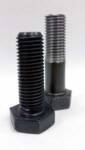
A193 is an ASTM (American Society for Testing and Materials) specification, whereas SA193 is from ASME (American Society of Mechanical Engineers). ASME repurposed the ASTM specification and added an “S”. The primary difference is the application. While both specifications are designed for high temperature / high pressure service, SA193 may also be used in nuclear... Read more
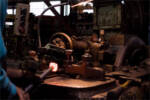
Portland Bolt uses National Upsetters to hot-forge the heads onto bolts. The end of the round bar is heated using an induction process and placed horizontally into the upsetter where a plunger compresses the heated steel into the shape of the bolt head. Because this process is a horizontal forging process, Portland Bolt is only... Read more
ASTM A687 was withdrawn in 1999. The specification covered high-strength non-headed steel bolts and studs. Below are the mechanical properties as well as Charpy Testing requirements: Yield Strength (KSI) Tensile Strength (KSI) Elongation % Reduction of Area % Foot-Lbs (Ave-min) Temperature 105 Min. 150 Max. 15 Min. 45 Min. 15 -20F While it is possible... Read more
No they do not. F1554 is a carbon steel, carbon boron, alloy, or high-strength low-alloy specification. F1554 has 3 strength grades, 36, 55, and 105. These numbers correspond to the minimum yield strength required. If corrosion resistance is required, F1554 anchor bolts can be hot-dip galvanized to the F2329 specification. If weathering steel anchor bolts... Read more
The short answer is, “No, you cannot match the A325 strength with stainless steel.” Some grades of strain hardened or quenched and tempered stainless steel fasteners will exceed the A325 strength requirements, but most standard stainless fasteners are not nearly as strong as A325 bolts. These bolts are very different chemically. Whereas stainless steels consist... Read more

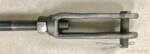
The easiest way to lock a tie rod assembly in place is by including an extra nut that can be run up against either the clevis or the turnbuckle. Once the nut has been jammed in place the assembly will be unable to move. These pictures show that the nut has to be placed on... Read more