
Newest FAQs
Portland Bolt maintains a comprehensive return policy to ensure clarity and confidence with every order. Our most current guidelines are always available on our Return Policy page, while previous versions, when applicable, can be found in our Downloads section.
The bars we use to manufacture your bolts are rolled by the steel mill with standard tolerances for diameter, out of roundness, and straightness. ASTM A6 covers many of these tolerances, as well as the chemical and dimensional tolerances for other shapes and plates. Because round bar is what we primarily use, we will stick... Read more
Yes, Portland Bolt will provide CMO paperwork for DOT projects in the US. The purpose of a CMO is to document the origin of materials used on a construction project. A CMO is required under the Buy America Act and applies to all federally funded highway construction projects. A CMO is used to certify that all... Read more
There are two possible causes for this. First is that oxidation can occur due to contamination from equipment that is used to make other carbon steel products. This can leave some iron deposits that will rust over time. This is only aesthetic, but can be unsightly. The second possibility is that the bolts were not... Read more
Yes. Portland Bolt has in the past assembled mesh, and other, thread protectors onto anchor bolts and headed bolts to protect the threads during shipping. However, for large construction fasteners, it is exceedingly rare this is required or needed. Typically our sturdy packaging and shipping practices will be more than sufficient to ensure that the... Read more
The A153 specification has 4 classes of material for hot-dip galvanizing: A. Castings – Malleable Iron, Steel B. Rolled, pressed, and forged articles C. Fasteners over 3/8” in diameter, washers 3/16” to 1/4” thickness D. Fasteners 3/8” inch in diameter and under, washers under 3/16” thick F2329 was created out of A153 to further define the... Read more
Even with the new F3125 specification that covers A325, Portland Bolt would not manufacture lag screws to F3125 Grade A325. According to section 1.2.1 under Intended Use in ASTM F3125, “Bolts manufactured under this specification are intended for use in structural connections covered in the Specification Joints Using High-Strength Bolts, as approved by the Research... Read more
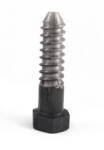
Unfortunately, Portland Bolt cannot manufacture fasteners with Unified National Fine threads. UNF thread series bolts are typically used in precision applications, such as automotive or machinery. Our threading equipment is unable to hold the required thread tolerance for UNF. Also, unlike cold-drawn steel, the hot rolled round bar we use to manufacture construction fasteners does not lend itself... Read more
Yes. Portland Bolt can partially galvanize an anchor bolt. However, it is far more common for anchor bolts to be fully galvanized. If hot-dip galvanizing is required, engineers sometimes specify that only the exposed, projecting end of an anchor bolt should be galvanized, while the rest of the anchor bolt that gets embedded into concrete... Read more
Although uncommon, there are times when a project’s specifications or plans call for the unthreaded portion of an anchor bolt to be wrapped with various kinds of tape. This tape typically starts at the bottom of the threads projecting from the concrete and will either travel the entire length of the anchor bolt or stop at... Read more