
Newest FAQs
This is a term that is frequently used across the industry. More often than not, “bridge washers” will refer to cast iron malleable iron washers. These washers are typically used in dock and wood construction. Malleable iron washers are specifically designed to prevent bolt heads and nuts from pulling into the wood. Detailers will also... Read more
A193 Grade B7M is a grade variation of the common A193 Grade B7 used in high-temperature, high-pressure applications. Nowhere in the A193 specification does it discuss whether or not A193B7M fasteners can be galvanized. In theory, there is nothing preventing someone from galvanizing the material, however, the application in which these bolts are intended to... Read more
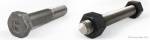
ASTM A153 is a broad specification covering zinc coating (hot-dip) of iron and steel hardware. In the past, A153 was the hot-dip galvanizing specification referenced by ASTM construction fasteners. The problem was that ASTM Committee F16 on Fasteners did not have any jurisdiction over this specification. Therefore, in 2005 the F2329 fastener-specific hot-dip galvanizing specification was established.... Read more
ASTM B633 is a broad specification covering electrodeposited zinc coating applied to iron or steel. In the past, this was the zinc plating specification referenced by ASTM construction fasteners. The problem was that ASTM Committee F16 on Fasteners did not have any jurisdiction over this specification. Therefore, in 1998 the F1941 fastener-specific zinc plating specification was... Read more
Portland Bolt’s stock ungraded coupling nuts are tapped all the way through from one end, while our high strength and custom manufactured coupling nuts are tapped from both ends. What does this mean for your project? Coupling nuts are typically intended to connect two separate threaded fasteners together, although some applications require the coupling nut... Read more
No they are not, although this is a somewhat recent change. In the 2015 version of the ASTM F1554 specification, the smallest diameter allowed was changed from ¼” to ½”. This means that prior to 2015, 3/8” diameter F1554 anchor bolts were allowable, but since then it is no longer an option. The F16 committee of... Read more
Every bolt grade has specific requirements including chemical makeup and strength properties. Virtually every grade of fastener also has diametrical limitations on both the small end and large end of sizes. For many grades the smallest diameter is ¼”, but some start at ½” (like ASTM F3125 and F1554). On the large end most bolts grades end... Read more
The simple answer is none. The two specifications were written in tandem to be identical. The only difference between the two bolts is intended application. A193 bolts are intended for high temperature and high pressure applications, while A320 bolts are for cold temperature applications. Both bolt grades are made from type 304 stainless steel, have the same mechanical... Read more
A194 2H nuts are a common high strength nut used with many different bolt grades, including A193 Grade B7, A325, A490, F1554 Grade 105 and others. Occasionally Portland Bolt will be asked to provide A194 Grade 2HM nuts, most often with A193 Grade B7M. In many grades an ‘M’ refers to metric, which is not... Read more
According to ASME, a global standards organization which provides manufacturers with guidelines and tolerances for producing parts, there are no listed dimensions to manufacture heavy square head bolts. However, ASME does provide dimensions for heavy square nuts. ASME B18.2.1 This standard covers the dimensional requirements for nine product types of inch series bolts and screws... Read more