
Newest FAQs
No. The specification calls out that those bolts must be Unified National Coarse thread and have class 2A tolerances. The F3125/F3125M specification reads: 4.2 Threads: 4.2.1 Uncoated bolt threads shall be as specified in Table 1. 4.2.2 Coated bolts shall have threads meeting Table 1 requirements before coating. TABLE 1 Thread Fit, ASME 120 ksi... Read more
The vast majority of bolts that Portland Bolt provides are either hot-dip galvanized or plain steel with no coating. In the construction fasteners industry, we typically refer to the plain steel as “black.” On our quotes and orders at Portland Bolt, we abbreviate that to “blk”. Other companies may refer to bolts with no coating... Read more
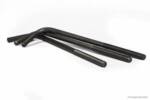
The A320 Grade L7M is a variation of the A320 Grade L7 specification used in low-temperature, low-pressure applications. Nowhere in the A230 specification does it discuss whether or not A320L7M fasteners can be galvanized. In theory, there is nothing preventing someone from galvanizing the material, however, the L7M designation comes from heat treating being the... Read more
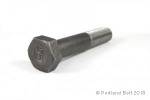
Stainless steel fasteners are often used in highly corrosive environments. When stainless nuts begin to rust, this can occur when hot forged nuts that are manufactured only to a material grade such as 18-8, SS304, and SS316 or to the ASTM A194 Grade 8 or 8M specifications. None of these steel grades or nut specifications... Read more
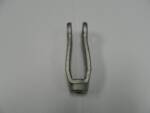
A clevis is a forged component at the end of a tie rod assembly that secures one end of a threaded rod to a structure. The “grip” of a clevis is the distance between the ears and is typically ¼” wider than the thickness of the connecting plate. This dimension is important so that the... Read more
The SAE J429 Grade 5 specification used to share the same head marking requirement as ASTM A449. A449 and Grade 5 are virtually identical both chemically and mechanically, but where the Grade 5 specification stops at 1-1/2” diameter, A449 continues up to 3”. They shared the three radial line head marking that Grade 5 still... Read more
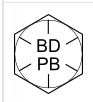
Portland Bolt manufactures both median barrier connecting pins and base stabilization pins for precast barriers used in many different states throughout the country. Although most states use a unique design for their pins, we have worked with several Departments of Transportation to approve our unique barrier pin. We designed the head of the pin to be... Read more
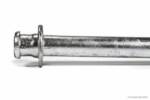
Yes, 12’ sticks of hot-dip galvanized all thread rod can not only be cut to smaller lengths, but it is often preferred. Depending on the application, all thread rod studs vary in length. For this reason, it is most common for all thread rod to be stocked in 12’ sticks, which can then be cut... Read more
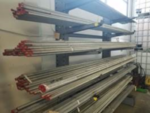
It depends. To answer this question, we have to go into the details about the different ways to we can thread a bolt. As well as different head styles. Roll Thread We can thread to within 2” of the head. We can thread up to 1” diameter bolts that are mild steel, stainless steel, or... Read more
If a Portland Bolt customer requests to return product, it is company policy to implement a 25% restocking fee. The reason for this charge is to cover the initial costs involved with processing the order. These costs include the salesperson’s time to quote and write the order, labor to pull and package the product, and... Read more