
Newest FAQs
A common question when deciding whether hot-dip galvanizing is an adequate corrosion resistant coating for a fastener is, “How long will the galvanizing last before the steel begins to corrode?” The last thing you want to do is install a bolt in a corrosive environment, only to have it begin to rust a year later. Unfortunately... Read more
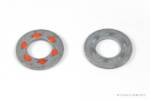
Load indicating washers are used to indicate the achievement of a specified minimum bolt tension. The ASTM specification covering load indicating washers is F959 and has two different types; 325 (type 1 and type 3) and 490 (type 1 and type 3). When used, the washer is typically placed beneath the head of the bolt. As the... Read more
Standard flat washers are a mass-produced item that Portland Bolt stocks as an accessory to accompany custom sized bolts we manufacture. A washer is a steel ring placed under a nut and/or bolt head to spread the pressure when the assembly is tightened. A washer also creates a smooth bearing surface for the nut to turn... Read more
A194 grade 7 nuts are commonly used nuts for both high temperature and low temperature applications, and is commonly paired with bolts made to either A193 or A320. When used in conjunction with A320 bolts in a low temperature application, or if specially requested, they are charpy tested to assure they will perform well in... Read more
Charpy testing, or impact testing was developed in 1905 by Georges Charpy in order to determine the amount of energy absorbed by a material during fracture. It was noticed that as the temperature drops, the tensile and yield of steel increases, but the ductility drops, leading to brittle and sometimes catastrophic failures. A standard Charpy... Read more
Yes, Portland Bolt manufactures crane mat rods. Crane mats (also known as timber mats, barge mats, road mats, swamp mats, pipeline mats, and floater mats) are wooden mats used for stabilizing machinery (often cranes) on unstable ground. They can also be used as a makeshift road, similar to a corduroy road. Crane mat rods are long threaded... Read more
SAE (AISI) 1045 in an “as rolled” condition will likely not meet the mechanical requirements of ASTM F1554 Grade 55. ASTM F1554 Grade 55 is a finished fastener specification with mechanical and chemical requirements. SAE 1045 has chemical requirements associated with it; however there are no mechanical requirements since it is a raw material specification, not a... Read more
The overtapping allowances for mechanically galvanized nuts are the same as overtapping allowances for nuts that are hot-dip galvanized. Mechanically galvanized nuts that adhere to ASTM B695 are “cold-galvanized,” which implies that they are coated with zinc at room temperature. Neither electricity (electroplate galvanizing) nor heat (hot-dip galvanizing) are applied in a mechanically galvanized process.... Read more
As far as the mechanical and chemical makeup of both A320 Grades L7 and L43, there isn’t much of a difference at all. The main difference is that the raw material used to make A320 L7 fasteners is typically 4140, whereas the raw material used to make A320 L43 is 4340. Below is information found... Read more
Unfortunately Portland Bolt does not have the capability to fabricate the wall mounts to which clevises attach. These fabricated lugs need to be designed by an engineer or architect to ensure they can withstand the loads applied to the tie rod assemblies. If you have a detailed drawing of the mounting brackets, we can have them... Read more