
Introducing Our New Left Angle Bend Anchor Bolt
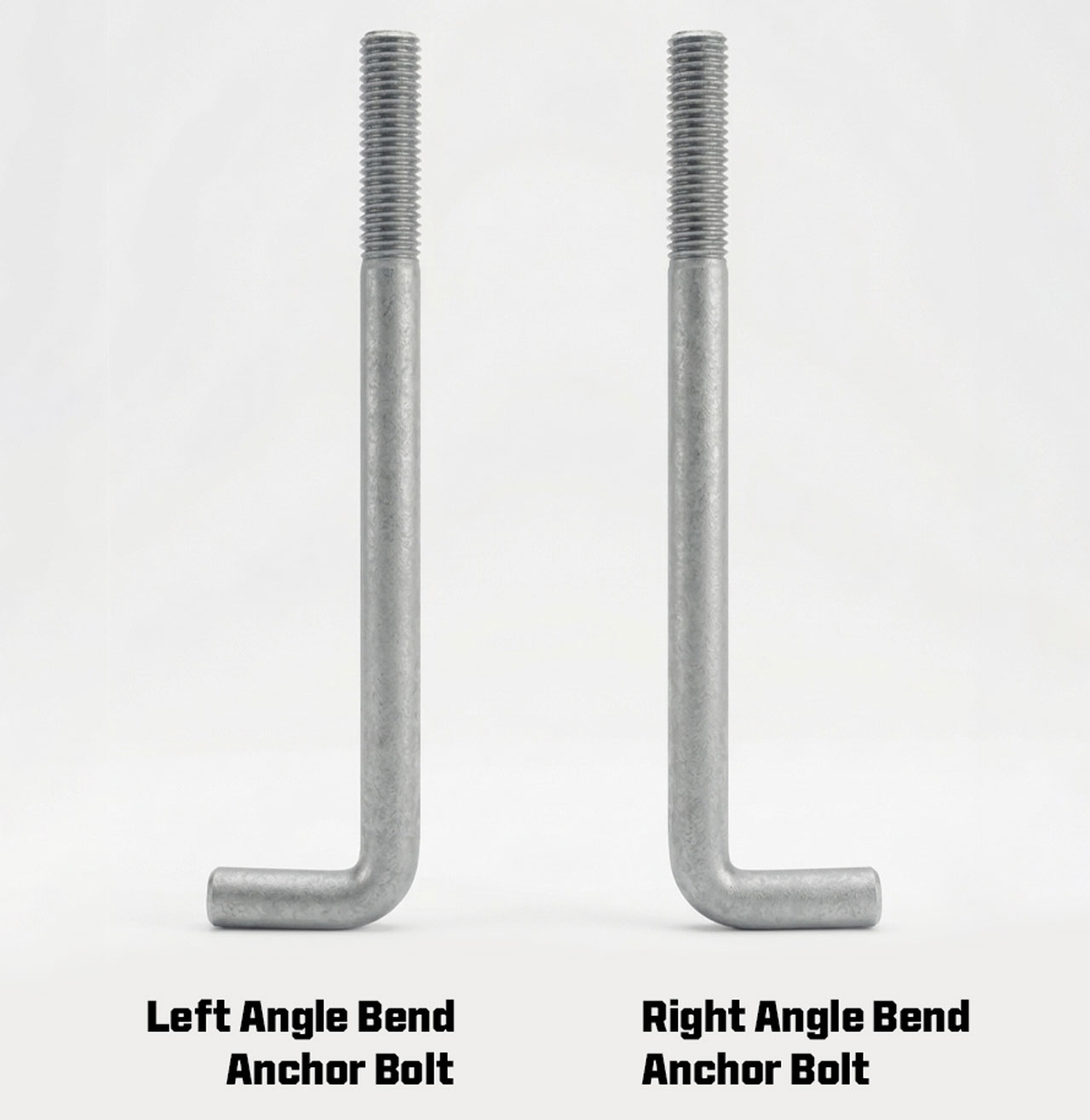
After years of rigorous research, development, and what can only be described as “turning things around,” we are proud to announce the official launch of our patented Left Angle Bend Anchor Bolt. While right angle bend anchor bolts have long been the industry standard for light poles and pre-engineered metal buildings, our engineering team asked the bold question: what if we went the other way? The result is a groundbreaking product that looks remarkably familiar—yet represents a complete rethinking of directional possibilities in anchor bolt technology.
This innovation has been quietly in development for years, undergoing extensive testing (including several successful rotations). The Left Angle Bend Anchor Bolt offers increased flexibility in foundation design, particularly in situations where the return on the embedded end of a traditional right angle bolt ends up too close to the edge of the foundation or pole base—or worse, interferes with rebar placement. By simply bending the opposite direction, these issues are elegantly resolved, opening the door to new levels of jobsite efficiency and installer satisfaction.
“Our team is excited to finally bring this to market,” said Todd McGurk, VP of Operations. “We’ve essentially unlocked a whole new dimension of anchor bolt orientation. The left angle configuration gives contractors another option when space constraints become a challenge. It’s the same reliability customers expect—just approached from a different angle.” We are now fully stocked and ready to supply Left Angle Bend Anchor Bolts for projects nationwide. Although it doubles our current inventory levels to carry both right angle and left angle bend anchor bolts, we expect the demand to offset the additional cost. Please consult your engineer—or a compass—when specifying direction.
Introducing Yesterday Delivery™
At Portland Bolt, we’ve heard it thousands of times: “We needed it yesterday.” For years, we pushed the limits of production and shipping speed, only to be held back by one unavoidable constraint: linear time. That is, until our team partnered with a group of theoretical physicists, a retired aerospace engineer, and one very confident guy with a whiteboard to develop Yesterday Delivery™—a logistics breakthrough rooted in highly advanced (and loosely verified) temporal mechanics.
Using a proprietary blend of relativistic time dilation, reverse-causal logistics modeling, and a carefully calibrated tachyon-assisted dispatch protocol, we’ve successfully decoupled shipment timelines from conventional space-time constraints. By briefly routing packages through a localized temporal inversion field—generated somewhere near our shipping dock—we’re able to create a closed-loop delivery window in which products exit our facility before they technically leave. While the math involves several Greek letters, a Möbius strip diagram, and at least one crossed-out equation labeled “probably fine,” the outcome is simple: we ship today, and it arrives yesterday.

“We’ve essentially achieved negative lead times,” said Zach Standish, Operations Manager at Portland Bolt Northwest, adjusting a clipboard that may or may not exist yet. “By synchronizing order fulfillment with a pre-emptive delivery state, we can meet even the most unrealistic deadlines.” While Yesterday Delivery™ is still being refined—and may occasionally result in duplicate shipments, temporal echoes, or customers remembering orders they haven’t placed yet—we’re confident this innovation will redefine expectations. So the next time you need it yesterday, don’t worry—we’re already on it.
Roll Threading: Stronger Threads, Smoother Performance
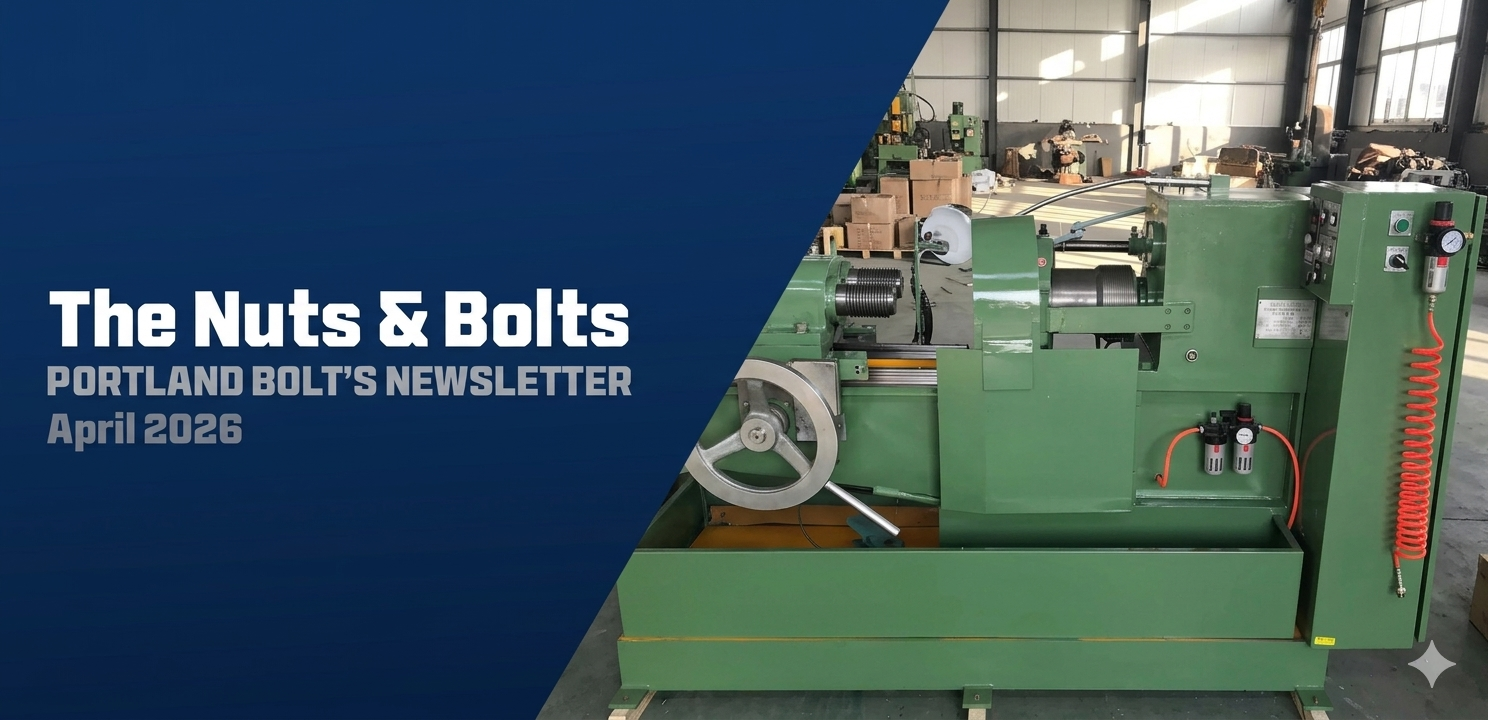
At Portland Bolt, we take pride in using the best equipment available—including our Waterbury Farrel flat die roll threader—to produce high-quality threaded fasteners. Unlike traditional cut threading, which removes material to form threads, roll threading displaces the steel under extreme pressure, forming threads by compressing and reshaping the material. This process results in threads with improved grain flow, increased strength, and a smoother surface finish that performs better under load.
Roll threaded parts also benefit from tighter dimensional consistency and enhanced fatigue resistance, making them ideal for demanding applications where durability matters. The process work-hardens the material, meaning the threads are often stronger than the base metal itself. In short, when performance counts, roll threading offers clear advantages over cut threading—and it’s one of the many ways we deliver superior products to our customers.
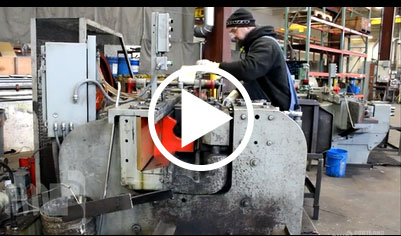
We’ve captured our very own Rick Tucker in action at the machine. Click below to watch Rick roll threads onto a square head machine bolt—it’s a great way to see the process up close and understand what sets roll threading apart.
#aprilfools