Welding High Strength Bolts

Question: Can welding be performed on high strength anchor bolts and fasteners?

Welding low carbon steel anchor bolt.Answer: The short answer is that in most cases, welding is not allowed on high strength bolts. In the fastener industry, the term “high strength” typically refers to any medium carbon or alloy material which undergoes a heat treating process to develop the strength properties necessary to meet the requirements of a given specification. These ASTM specifications include A449, A325, A193 grade B7, F1554 grade 105, A354 grades BC and BD, and A490 among others. When heat is reapplied to a bolt that has been heat treated, it is probable that the physical properties (strength) of the bolt may be altered. When heat is applied in an uncontrolled environment, it is impossible to determine what effect this application of heat has had on the fastener. Therefore, welding to high strength bolts is not recommended.

Two references occur to back up this statement. On page 4-4 of the Ninth Edition of the AISC Manual (American Institute of Steel Construction), the following statement occurs:

“Anchor bolt material that is quenched and tempered (heat treated) should not be welded or heated.”

The other reference prohibiting the heating of high strength bolts (which would occur during welding) can be found in the ASTM F1554 specification. Section 6.4.3 of the ASTM F1554 specification states:

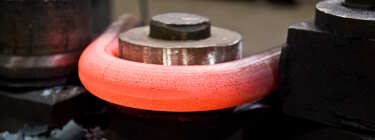
“Hot bending performed on heat-treated bar stock shall not have the temperature come within 100°F (56°C) of the tempering (stress relieve) temperature of the heat-treat process at any location during hot bending and shall be allowed to air cool after bending.”

Although this statement refers to hot bending, it implies that any process (including welding) that applies heat approaching or exceeding the tempering temperature to a high strength bolt may potentially alter the mechanical properties of the fastener and should therefore be avoided.

The issue of reheating high strength bolts when welding can be avoided by performing the welding operation prior to the fastener undergoing the heat treating process. In other words a plate, nut, or other component can be welded to a bolt prior to the fastener being heat treated. However, this must be performed by a fastener manufacturer and eliminates the ability for high strength bolts to be welded in the field or by another company once the bolts have been tested and certified to meet a particular ASTM specification.

Posted by Greg Lindsay

Phone: (800) 599-0565 Email: greg@portlandbolt.com View other posts by

AddThis Social Bookmark Button

The below content is submitted by readers and has not been researched or checked for accuracy. It is not endorsed in any way by Portland Bolt.

7 Responses to “Welding High Strength Bolts”

  1. Troy C. says:

    Can you tell me if an A615 Grade 75 threaded anchor bolt can be heated and straightened without reducing the strength. We have several bars that are roughly 8′ long which are bent about 1/2″ out of straight over the last 1′-6″ foot of length.

  2. Adam Oakley says:

    @Ted Welti: High strength nuts used with A325 bolts are heat treated and should not be taken past their tempering temperature (i.e. welding), since this can change the mechanical properties. Although, we often see engineer’s designs that include high strength nuts welded to plates. The main concern is that it is impossible to know, without testing, what effect the welding will have on the nut’s strength. Many believe that a few tack welds will not significantly alter the strength of the nut. We have no engineers on staff and don’t make any recommendations about this method.

  3. Ted Welti says:

    Is it allowed to weld a nut to the back side of a steel plate for a slip-critical ASTM A325 bolt connection? There would be no welding done to the bolt itself, just the nut. The nut would be centered over a hole in the steel plate and welded to the plate in the shop. This is so in the field the bolt could be installed without access to the backside to hold the nut from spinning when the bolt was tightened. This is for attaching a brick shelf angle to the outside of a cold-formed steel wall that will be sheathed in the shop before being tilted into place in the field.

  4. Adam Oakley says:

    @Soo: A307 grade C is usually made from A36 steel which is weldable. Don’t forget that ASTM has removed grade C from A307 and replaced it with F1554 grade 36.

  5. Soo says:

    what about ASTM A307 grade C..?
    is it possible to re-use anchor bolts after welding?

  6. Adam Oakley says:

    @Ben Valdez: Any quenched and tempered bolt that has a minimum tensile strength lower than 150ksi can be galvanized. There is no problem galvanizing A193 B7. However, any quenched and tempered fastener (A193 grade B7 included) that develops its strength properties through a heat treating process should not be welded. If you need to weld to the fastener, the highest strength bolt available would be F1554 grade 55.

  7. Ben Valdez says:

    I am looking for bolts that are close to ASTM A193
    B7 that are weldable and can be galvanized.

Leave a Reply

*Please note: Your comment will not appear on the site until it has been moderated. We will approve and posts comments as soon as we are able.


Ask the Expert is powered by WordPress | Entries (RSS) | Comments (RSS).