Newest FAQs
In our Live Chat, numerous customers have asked us about tolerances under the F1554 specification relating to things like diameter, length, straightness, and many other parameters. While a customer always has the option of specifying a particular set of tolerances they may require for any bolt, what are the default tolerances for anchor bolts under... Read more
The answer to this question is no. As stated in Section 1.1, the F1554 specification covers various configurations of, “…carbon, carbon boron, alloy, or high-strength alloy steel anchor bolts.” In general terms, for a steel to be considered “stainless” it must contain at least 10.5% chromium as part of its chemical composition and will often... Read more
You can watch a video covering four of these point types: the chamfer, semi-cone, chisel, and 45-degree angle cut. Saw cut end When a large diameter or small quantity of bolts is required, Portland Bolt will saw cut the steel round bar to create the cut lengths for the finished fastener. A saw cut end... Read more
Mechanical galvanizing (ASTM B695) is a process in which fasteners are tumbled in a barrel with a mixture of water, zinc powder, other chemicals, and glass impact beads. As the parts are tumbled in the slurry, the zinc is “cold welded” to the fasteners. While some mechanical galvanizers can process parts that over a foot... Read more
Our two main concerns with providing galvanized bolts larger than 1-1/2” diameter with 8 threads per inch is the lack of overtap allowance standards for the mating nut and the potential for premature thread stripping due to the nut oversizing. Overtap Allowances All inch series hot dip galvanized hex nuts, regardless of grade, are tapped... Read more
There are several differences between bolts intended for use in construction and more precision fasteners, such those used in an OEM application. One difference for headed bolts is the process in which the head is formed on the bolt and the resulting appearance of the bolts. Larger, construction headed bolts are typically made by hot-forging... Read more
The anchor rods in this photo were damaged because they were covered with snow and the equipment operator did not see them. Every situation is different, and we try to not make recommendations where bent anchors are concerned as we feel it is a question better answered by the project engineer, as he/she will be... Read more
Several ASTM specifications are followed by an “M” that denotes it being an equivalent metric standard. While there is actually an A193M Grade B7 specification which is applicable to metric fasteners, this is not the case with ASTM A193 Grade B7M. This is a different grade of material than A193 Grade B7. So how exactly... Read more
The answer to this question is no. The ASTM F1554 specification defines tolerance ranges for various dimensional requirements such as thread dimensions, thread length variance, overall length, (and in the case of bent anchor bolts) bend section, hook length, and bend length. However, no tolerances are given for straightness. The reason for this is because... Read more
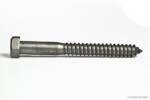
A lag screw, also referred to as a lag bolt, is a heavy wood screw with a spiral thread and a hex or square head used for driving it into wood. Large diameter lag screws typically do not require gimlet points because of the need for a pilot hole to lower the torque required to... Read more