
Newest FAQs
The term “high strength” is a somewhat ambiguous fastener term. Most people in the industry would interpret the phrase “high strength” to refer to any bolt that has been quenched and tempered (heat treated) to develop its strength. Additionally, the ASTM specification F1554 Grade 55 is commonly referred to as being manufactured from a “high... Read more
AASHTO is the American Association of State Highway and Transportation Officials. This organization sets standards for highway design and construction. As it relates to bolts, often times, bolts and other materials will be shown on plans for state transportation projects as having an AASHTO designation. These AASHTO numbers typically will correlate directly to a particular... Read more
I have noticed in specifications from multiple organizations that ASTM A193 Grade B7 bolts are selected along with ASTM A194 Grade 2H nuts. I know that from ASME B16.5 Flanges and Flanged Fittings, the recommended high strength bolt is ASTM A193 Grade B7. However I cannot find in ASTM A193, A194, ASME B16.5, B18.2.1, B18.2.2, B31.1... Read more
A common misconception is that stainless steel is non-magnetic. There are five classes of stainless steel, and only one is non-magnetic. However, it just happens to be that the most widely used type (austenitic) is the one that is not magnetic. Class Magnetic? Common Types Ferritic Yes 430,442 Austenitic No 304,316 Martensitic Yes 410,416 Duplex... Read more
Basically, there are 3 different configurations of threads: Full-body cut thread Reduced-body rolled threads Full-body rolled threads Full Body Cut Thread Full body cut threads use full size round bar and the threads are cut into the steel. This is a commonly used method, especially on larger diameter products, long length products, and small quantity... Read more

The short answer to this question is no. However, there are many variables with regard to the protective coating that prevents the internal threads of a galvanized nut from corroding. In this FAQ, we will explore some of the variables brought about by this question. One of the first issues to address is the question... Read more
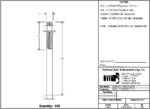
Yes we do. Our quoting program is designed to automatically send drawings with all items we quote. We can also create any other drawings you may need. Drawings minimize the possibility of both verbal miscommunication and written misinterpretation. Our drawings will define exactly what we are planning to supply and give you the ability to... Read more
Yes. 44W / 300W is the Canadian version of A36 steel, and is a grade within the CSA G40.21-04 specification. The Canadian Standards Association specification G40.21 covers structural quality steel plates, shapes, sheet, sheet piling, cold-formed channels, hollow sections, Z sections, and bars. 44W steel has slightly higher mechanical requirements than A36, which are summarized... Read more
While there is certainly nothing to preclude ASTM A193 B7 from being specified for anchor bolts – and Portland Bolt manufactures them quite often – the specification is not intended for anchor bolt use. ASTM F1554 Grade 105 is a specification specifically developed for anchor bolts and possesses virtually identical chemical and physical properties. ASTM... Read more
According to ASTM A490-11, the answer is no. The A490 specification only covers diameters from 1/2″ to 1-1/2″, inclusive. An A490 bolt cannot be made above 1-1/2″ diameter; ASTM does not allow it. Since there are no chemical requirements, hardness requirements, or strength requirements for A490 fasteners above 1-1/2″ diameter, no manufacturer would be able... Read more