
Newest FAQs
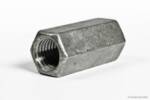
There are no documented standards for load ratings of coupling nuts or sleeve nuts. These types of connections are not specified for any uses for which load rating would be required. If a connection is used to suspend or tension a load, which is achieved with products like tie-rod assemblies, then the connection products have... Read more
No, mixing and matching different types of galvanized products is not advised. From ASTM A563/A307/A354 and F1554: “4.7.4 When no preference is specified, the supplier may furnish either a hot-dip zinc coating in accordance with Specification F2329, or a mechanically deposited zinc coating in accordance with Specification B695, Class 55. Threaded components (bolts and nuts)... Read more
Both are produced via the hot dip process, but with slightly different processing steps. G90 is a coating grade within the steel sheet specification ASTM A653, and is produced by uncoiling steel coils and running it at high speed through the pickling process and molten zinc before it passes through an air curtain, which creates... Read more
2015 Update: Yes, ASTM A490 bolts can now be fully threaded. There is a supplemental provision in the F3125 specification that allows the bolt to be fully threaded as long as it is stamped with an “S”. The A490 specification starts at ½” diameter and stops at 1-1/2” diameter, and each diameter has its own specific thread length... Read more
Headed bolts are required to be stamped on top of the head, while most rods and some bent bolts are required to be stamped on one end. This Fastener Identification Markings Chart shows the various marking requirements for most common grades of ASTM and SAE fasteners. Headed Bolts ASTM specifications require a manufacturer’s identification and... Read more
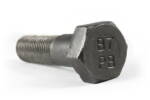
Often times, ANSI (American National Standards Institute) or ASME (American Society of Mechanical Engineers) B18.2.1 will show up on a drawing, some certification documents, and even our website . This number simply refers to dimensional standards for a variety of common bolts, such as hex bolts, heavy hex head bolts, and square head bolts. Most... Read more
Stamping the heads of F1554 anchor bolts is not required per the ASTM Specification, but Portland Bolt chooses to do so to provide a secondary identification. Product Marking ASTM F1554 anchor bolts are marked on the threaded end that projects from the concrete with a designating color code, as is required by the specification. Marking... Read more
Proof strength, or proof load, is the full size equivalent of a yield test. Yield testing is typically only performed on machined specimens. In most fastener standards, full size testing is the preferred method, and the referee method if there is a discrepancy between the two test results. Because of the difficulty of getting reliable... Read more
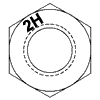
There is no published requirement for making sure the ID marks are on the outside and visible. The main concern would be being able to ascertain that the proper nuts were installed. If all the ID markings are on the inside, they would not be visible, and an inspector could not see them. That said,... Read more
Yes, A325-3 and A490-3 are made from weathering steel containing copper, chromium, and nickel which induces the surface to form a heavy oxide coating that protects the base material from corroding any further. This brownish-red coating seals the material from corrosion much like other external coating options. These types of bolts are more often used... Read more