Newest FAQs
As far as the mechanical and chemical makeup of both A320 Grades L7 and L43, there isn’t much of a difference at all. The main difference is that the raw material used to make A320 L7 fasteners is typically 4140, whereas the raw material used to make A320 L43 is 4340. Below is information found... Read more
Unfortunately Portland Bolt does not have the capability to fabricate the wall mounts to which clevises attach. These fabricated lugs need to be designed by an engineer or architect to ensure they can withstand the loads applied to the tie rod assemblies. If you have a detailed drawing of the mounting brackets, we can have them... Read more
Due to the fact that Portland Bolt is a manufacturer of nonstandard anchor bolts and construction fasteners, the vast majority of the product that we manufacture and sell to our customers is custom and is manufactured to the specific requirements of the job they are being used on. Portland Bolt is not a large scale,... Read more
Transcript Hello, my name is Amanda Seal. I work as an inside sales/estimator at Portland Bolt and manufacturing. I’ve been working with the company since October 2014, although we have over 100 years combined industry experience working in the sales office. Before I came to Portland Bolt, I lived and grew up here in Alaska. Here... Read more

Portland Bolt’s Torque Chart includes approximate torque values for fastener specifications made from carbon steel and alloy steel. We have chosen to exclude torque values related to fastener specification made from stainless steel. The primary reason we have decided to omit stainless fastener specifications from our torque chart is because we are unable to locate... Read more
I have a client out of Israel and they manufacture equipment for use in power plants. They have a question about anchor bolts in seismic zones. They want to use anchor bolts made from SAE 4340 material and they would like to know if that is equivalent to ASTM F1554 material. Will this material be... Read more
Timber bolts, also referred to as economy bolts in the Pacific Northwest, are designed with a round oversized head which eliminates the need for a washer underneath the head. The underside of the head has two nubs which bite into wood and prevent the head from spinning in the timber. The nubs under the head... Read more
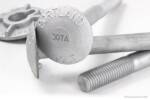
The tolerances for A193-B7 are governed by section 4 of the specification, which states, “Material and fasteners supplied to this specification shall conform to the requirements of Specification A 962/A 962M. These requirements include test methods, finish, thread dimensions, marking, certification, optional supplementary requirements, and others.” Studs (also known as All Thread Rods) would be... Read more
ASTM F1554 does specifically state in Section 6.4 that the manufacturing company can substitute weldable F1554 Grade 55 material in place of F1554 Grade 36 material at the option of the manufacturing company. So technically your supplier is correct that they can substitute F1554 Grade 55 for F1554 Grade 36 at any time, as long... Read more
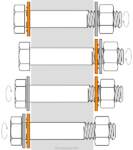
According to the Research Council on Structural Connections (RCSC December 31, 2009 edition), an F436 washer is used in addition to a DTI washer with an A325 structural bolt. RCSC’s Specification for Structural Joints Using ASTM A325 or A490 Bolts, Section 6 Use of Washers, states that a ASTM F436 washer is always used, but... Read more