Rolled vs Cut Thread Bolts
Question: What is the difference between a bolt with rolled threads and one with cut threads and does a fastener with a reduced body and rolled threads meet ASTM specifications?
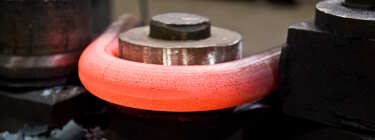
Answer: Threads of a mechanical fastener, regardless of whether it is a headed bolt, rod, or bent bolt, can be produced by either cutting or rolling. The differences, misconceptions, advantages, and disadvantages of each method are described below.
Cut Threads
Cut threading is a process by which steel is cut away, or physically removed, from a round bar of steel to form the threads. A 1″ diameter bolt, for example, is produced by cutting threads into a full 1″ diameter body of the bolt.
Advantages of Cut Threading
- Few limitations with regard to diameter and thread length.
- All specifications can be manufactured with cut threads.
Disadvantages of Cut Threading
- Significantly longer labor times means higher costs.
Rolled Threads
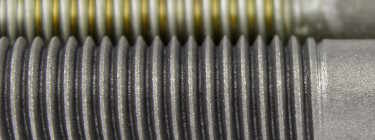
Roll threading is a process by which steel is extruded to form the threaded portion of a fastener, instead of being removed as in cut threading. In this process, a bolt is manufactured from a reduced diameter round bar. For example, a 1″ diameter bolt is manufactured from .912″ diameter round bar. This “pitch diameter” material is approximately the midpoint between the major diameter (peaks) and minor diameter (valleys) of the threads. The bolt is “rolled” through a set of threading dies which displaces the steel and forms the threads. The end result is a fastener with a full 1″ diameter threaded portion but a reduced body diameter (.912). Roll threading is an extremely efficient process and often results in significant cost savings. Therefore, Portland Bolt will roll threads whenever possible.
Roll Threading Misconceptions
- Roll threaded bolts do not meet ASTM specifications.
- A bolt with a reduced body will be weaker than a bolt with a full sized body.
Technically, any specification with the exception of A325 and A490 structural bolts can be produced with a reduced body and rolled threads.
The weakest area of any mechanical fastener is the minor diameter of the threads. Since the thread dimensions of a cut thread and rolled thread fastener are identical, there is absolutely no difference in strength. One could actually argue that the work hardening which occurs during the roll threading process may even make the fastener with rolled threads stronger. Additionally, cut threading interrupts the natural grain structure of the round bar whereas roll threading reforms it. One could again argue that cutting into the grain of a round bar when cut threading may produce threads which have less structural integrity than a part which has been roll threaded.
Advantages of Roll Threading
- Significantly shorter labor times means lower costs.
- Because a roll threaded bolt has a smaller body diameter, it weighs less than its full bodied counterpart. This weight reduction reduces the cost of the steel, galvanizing, heat-treating, plating, freight, and any other costs associated with the fastener that are based on weight.
- Cold working makes threads more resistant to damage during handling.
- Rolled threads are often smoother due to the burnishing effect of the rolling operation.
Disadvantages of Roll Threading
- Portland Bolt is limited to a maximum diameter of 1″ and a maximum thread length of 8″.
- The availability of pitch diameter round bar is limited for certain material grades.
- 150 ksi minimum tensile strength material is too strong for Portland Bolt to roll thread.
- A325 and A490 structural bolts cannot be produced with a reduced body diameter.
- In rare wood applications where shear strength is the critical requirement, bolts with a full sized body may be required.
Pitch Diameter Stock Nominal Diameter Stock

| Coarse Thread | Rolled Thread Stock Weight |
Cut Thread Stock Weight |
Weight Savings % |
||
|---|---|---|---|---|---|
| Size | diameter, in. |
lb. per ft. |
diameter, in. |
lb. per ft. |
|
| 3/8″ – 16 | 0.330 | 0.291 | 0.375 | 0.376 | 22.6 |
| 1/2″ – 13 | 0.445 | 0.529 | 0.500 | 0.668 | 20.8 |
| 5/8″ – 11 | 0.562 | 0.843 | 0.625 | 1.043 | 19.2 |
| 3/4″ – 10 | 0.680 | 1.235 | 0.750 | 1.500 | 17.7 |
| 7/8″ – 9 | 0.797 | 1.696 | 0.875 | 2.044 | 17.0 |
| 1″ – 8 | 0.912 | 2.221 | 1.000 | 2.670 | 16.8 |


@akhil Unfortunately, this question is beyond our expertise as we only manufacture bolts with Imperial dimensions.
August 23, 2011 at 11:34 amplease let me know the basic diameter used for M16, in thread rolling machinem
August 8, 2011 at 9:58 pmMy company bought US$200,000 worth of 16mm to 24mm rolled anchor bolts from a supplier in China.
May 13, 2011 at 5:36 amOur engineer claims that the narrower shank (in the case of 20mm goes down to 18.3mm) will not comply with ASTM standards. Is he correct? as I understand that the narrower diameter will have no adverse effect mechanical properties. Note we use our anchor bolts for Pre Engineered Buildings.
Your expert advise will be appreciated. Rgds Barry
Great Info! Thank you, I use alot of B7 Studs in the water utility industry and this just enlightened me. Any info in the future is much appreciated. Thanks, Jim
October 26, 2010 at 11:35 am@Freddy Keener – Cutting the threaded portion of the bolt won’t have any effect on the strength of the bolt. The only factor to worry about in a situation like that is that you leave the amount of thread needed to achieve minimum thread engagement.
January 6, 2010 at 8:20 amDoes a rolled thread fastener become weaker than its equivalent cut thread fastener when cut to a shorter length?
January 4, 2010 at 5:24 pmwhy don’t you roll thread anything over 150KSI??
November 10, 2009 at 4:53 pmIs there a visible difference between rolled and cut threads? I’ve heard that it may be possible to tell based on the curvature of the thread root, but I can’t find a source anywhere that says so either way.
June 27, 2009 at 4:56 amASTM allows full body A325 bolts to be roll threaded. However, reduced body roll thread, which is the process that Portland Bolt uses and is the topic of this article is not allowed. ASTM states that A325 and A490 structural bolts must meet the dimensional tolerances of ANSI 18.2.6 that would not allow the use of reduced body pitch diameter material. For A449 fasteners it references ANSI 18.2.1 for the dimensional tolerances. This specification allows a reduced body diameter to be used if the manufacturer and purchaser agree. Since the reduced body pitch diameter material is between the major and minor thread dimensions, it is usually allowed for most applications.
March 19, 2009 at 10:11 amIf you’re stating that A325 bolts should not be roll threaded. What is you opinion on roll threading non-head A449 bolts and A449 fully threaded studs?
March 19, 2009 at 9:22 amPortland Bolt has two methods of threading bolts. Roll threading is mainly limited by diameter (up to 1″) and material grade restrictions. This is a very fast way of threading large quantities and produces a very cost effective bolt. Cut threading is primarily used for bolts over 1″ up through 6″ in diameter, high strength fasteners, and smaller manufacturing runs. Since we have two threading options, the most effective method is selected for each order, saving customers time and money. We specialize in large non-standard anchor bolts for the light pole and traffic signal industry.
March 18, 2009 at 2:24 pmWHY IS PORTLAND BOLT LIMITED TO A MAXIMUM 1″ DIAMETER” I WOULD THINK IN THE CONSTRUCTION TRADE, BOLTS CAN GET UP TO 2 1/4″ IN DIAMETER..i.e TRAFFIC SIGNAL POLES.
March 18, 2009 at 12:07 pmThanks for adding your expertise, Doug. You are correct no one should ever make changes to specifications without the engineer’s approval. An elaboration on note 5 under “Disadvantages of roll threading” briefly talks about this concern. We don’t have any engineers on staff and always recommend that they be consulted before any changes are made.
March 18, 2009 at 10:30 amThe shank diameter of bolts connecting timber components can be critical. Bending strength in longer bolts may control the capacity of the connector. A .912” diameter bolt through a 10 ¾” timber member would have ~18% less load capacity than a 1.000” diameter bolt. Rolled thread bolts should not be used in timber systems unless done so with the blessing of the designer/specifier.
March 18, 2009 at 7:24 amBolt design equations can be found ANSI/AF&PA NDS-2005, Part 11.3.
What is “pitch diameter”? What are the material diameters before threading for “strandard” sizes? Is there such a thing as a “handy dandy” chart/table? I run a service as “ask the metallurgist” for my firm and get asked quite often. thank you, JG
February 2, 2009 at 1:59 pmDarrell » I’m not familiar with the specification you reference in your question. Our knowledge is focused on construction fastener products and it sounds like this may be out of the scope what you’re researching. All roll thread product we provide are externally threaded. If you are not able to find an answer can I run this by operations manager.
March 11, 2008 at 2:18 pmI know you can make an acceptable external thread per ASE AS8879, but is this also true for an internal thread? The ones I’ve seen have the appearance of being double thd’d.,lacking material streangth near the pitch line.
March 11, 2008 at 8:06 amThanks for posting the helpful link, Terence.
February 19, 2008 at 5:06 pmFor additional technical information on anchor bolts (roll vs. cut), please see DSA IR 22-2 at http://www.documents.dgs.ca.gov/dsa/pubs/IR_22-2_revised_11-01-07.pdf
February 19, 2008 at 4:35 pm