Galvanizing High Strength Bolts
Question: Can high strength bolts be hot-dip galvanized?
Answer: Some high strength bolts can be galvanized while others cannot. In the construction fastener industry, typically the phrase “high strength” refers to bolts that have been quenched and tempered (heat treated) to develop the proper strength requirements of a given specification. Two separate issues are involved in determining whether or not a high strength bolt can be galvanized.
Hydrogen Embrittlement Concerns
The first issue involves a phenomenon called hydrogen embrittlement which may occur when atomic hydrogen is absorbed by the steel during the acid pickling process that takes place prior to galvanizing. This embrittlement can potentially lead to the loss or partial loss of ductility in the steel and consequently result in the premature failure of the fastener in the field.
According to specification ASTM A143 – Safeguarding Against Embrittlement of Hot-Dip Galvanized Structural Steel Products and Procedure for Detecting Embrittlement:
“In practice hydrogen embrittlement of galvanized steel is usually of concern only if the steel exceeds approximately 150 ksi (1100 MPa) in ultimate tensile strength.”
Additionally, section 7.2.2 of specification ASTM F2329 – Zinc Coating, Hot-Dip, Requirements for Application to Carbon and Alloy Steel Bolts, Screws, Washers, Nuts, and Special Threaded Fasteners reads as follows:
“For high strength fasteners (having a specified minimum product hardness of 33 HRC), there is a risk of internal hydrogen embrittlement.”
By reviewing Table 1 below, it is clear that specifications ASTM A490, ASTM A354 grade BD, and SAE J429 grade 8 are all potentially susceptible to hydrogen embrittlement and should therefore not be hot-dip galvanized. This is further reinforced by specific references found in both the ASTM A490 specification and the ASTM A354 specification. According to section 4.3 – Protective Coatings of specification ASTM A490:
“The bolts shall not be coated by hot-dip zinc coating, mechanical deposition, or electroplating with zinc or other metallic coatings.”
Similarly, Note 4 in section 4 of specification ASTM A354 reads as follows:
“Research conducted on bolts of similar material and manufacture indicates that hydrogen-stress cracking or stress cracking corrosion may occur on hot-dip galvanized Grade BD bolts.”
This information taken directly from the ASTM specifications supports the belief that hot-dip galvanizing of ASTM A490, ASTM A354 grade BD, and SAE J429 grade 8 should be avoided due to the risk of hydrogen embrittlement.
Which Bolt Grades Can Be Galvanized?
| Grade | Can I Galvanize? | Raw material | Nominal Size | Minimum Yield Strength | Minimum Tensile Strength | Minimum Hardness |
|---|---|---|---|---|---|---|
| ASTM A325 | Yes | Medium Carbon Steel, Quenched and Tempered | 1/2″ – 1″ 1 1/8″ – 1 1/2″ |
92 81 |
120 105 |
C24 C19 |
| ASTM A449 | Yes | 1/4″ – 1″ 1 1/8″ – 1 1/2″ 1 5/8″ – 3″ |
92 81 58 |
120 105 90 |
C25 C19 B91 |
|
| SAE J429 Grade 5 | Yes | 1/4″ – 1″ 1 1/8″ – 1 1/2″ |
92 81 |
120 105 |
C25 C19 |
|
| ASTM A193 Grade B7 | Yes | Medium Carbon Alloy Steel, Quenched and Tempered | 1/4″ – 2 1/2″ 2 5/8″ – 4″ |
105 95 |
125 115 |
NA |
| ASTM A354 Grade BC | Yes | 1/4″ – 2 1/2″ 2 5/8″ – 4″ |
109 94 |
125 115 |
C26 C22 |
|
| ASTM F1554 Grade 105 | Yes | 1/4″ – 3″ | 105 | 125 | NA | |
| ASTM A320 Grade L7 | Yes | 1/4″ – 2 1/2″ | 105 | 125 | NA | |
| ASTM A490 | No | 1/2″ – 1 1/2″ | 130 | 150 | C33 | |
| ASTM A354 Grade BD | No | 1/4″ – 2 1/2″ 2 5/8″ – 4″ |
130 115 |
150 140 |
C33 C31 |
|
| SAE J429 Grade 8 | No | 1/4″ – 1 1/2″ | 130 | 150 | C3 |
Effect of Heat on Quenched and Tempered Fasteners
The second issue of concern when considering hot-dip galvanizing high strength fasteners is potentially reducing the mechanical strengths due to the introduction of heat during the hot-dip galvanizing process. Portland Bolt operates its hot-dip galvanizing tank at 840° Fahrenheit. Is this enough heat to potentially alter the strength of a quenched and tempered fastener? In theory, the amount of heat that a high strength fastener is exposed to during the hot-dip galvanizing process should not alter its mechanical properties.
It is obvious that the application of heat to a bolt that develops its strength through a heat treating process could adversely affect the strength of the fastener. The question is, how much heat is necessary to potentially change the mechanical properties? On page 4-4 of the Ninth Edition of the AISC Manual (American Institute of Steel Construction), the following statement occurs:
“Anchor bolt material that is quenched and tempered (heat treated) should not be welded or heated.”
However, it does not address the amount of heat that should be avoided. Welding obviously applies a tremendous amount of heat to the components being welded, whereas hot-dip galvanizing is performed at significantly lower temperatures. Another reference that addresses the heating of high strength bolts (which occurs during hot-dip galvanizing) can be found in the ASTM F1554 specification. Section 6.4.3 of the ASTM F1554 specification states:
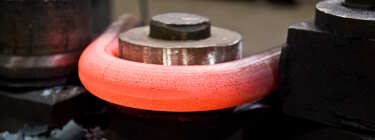
“Hot bending performed on heat-treated bar stock shall not have the temperature come within 100°F (56°C) of the tempering (stress relieve) temperature of the heat-treat process at any location during hot bending and shall be allowed to air cool after bending.”
Although this statement refers to hot bending, it implies that any process (including galvanizing) that applies heat approaching or exceeding the tempering temperature of a high strength bolt may potentially alter the mechanical properties of the fastener and should therefore be avoided. However, galvanized bolts only remain in the zinc tank for a few minutes and even though the surface temperature may approach 840°, it is unlikely that the entire fastener is heated to that temperature. The most relevant reference found in any ASTM specification addressing the possibility of the hot-dip galvanizing process altering the mechanical properties of a high strength fastener is found in section 7.2.1.2 of the new hot-dip galvanizing specification ASTM F2329 which states:
“Testing for mechanical properties is not necessary if the galvanizing process is carried out at a lower temperature than the stress relief or tempering temperature of the fasteners.”
This implies that the mechanical properties have the potential to be altered only if high strength bolts are tempered at temperatures at or below the 840° temperature that the bolts are subjected to during hot-dip galvanizing. As Table 2 indicates below, the minimum tempering temperature for both ASTM A193 grade B7 and ASTM F1554 grade 105 is 1100° Fahrenheit. Therefore, it is not possible for the galvanizing temperatures to exceed the tempering temperature for these specifications. Although in theory it is possible for the other specifications to be tempered below the galvanizing temperature, recent records indicate that the minimum tempering temperature used for any of these grades listed in Table 2 that Portland Bolt has manufactured is 950°. Therefore, hot-dip galvanizing performed by Portland Bolt on any of the high strength bolt specifications listed in Table 2 will not adversely affect the strength of these fasteners.
Minimum Tempering Temperatures
| ASTM Grade | Minimum Tempering Temperature, Fahrenheit |
|---|---|
| A325 | 800° |
| A449 | 800° |
| A354 Grade BC | 800° |
| A320 Grade L7 | No Requirement |
| A193 Grade B7 | 1100° |
| F1554 Grade 105 | 1100° |


See this FAQ for details on corrosion protection options for high strength bolts.
April 9, 2009 at 9:38 amWhat is the safiest alternative (without modifying the strenth) to protect a A490 bolt from corrosion if those treatments (galvanazing and all)is not recommended?
April 1, 2009 at 9:48 amI agree with Adam on this issue. Grade 8 bolts should not be galvanized. I am not aware of anyone stocking galvanized grade 8 bolts. It may be possible the word “galvanize” used for grade 8 bolts actually refers to the older term “electro-galvanize”, which is actually standard zinc plating, not hot-dip galvanize. Zinc plating is fine for Grade 8 bolts.
February 25, 2009 at 3:00 pm@Michael Nietch: Thanks for your input regarding this topic. Galvanizing high strength bolts is a complicated subject and the discussion helps to better clarify the issues.
1. Hardness is a rough estimate of tensile. Generally speaking a 34 Rockwell equals 150 ksi tensile. The chart above doesn’t include A193 B7 hardness, since it has no minimum. There is slight overlap between the minimum Grade 8 hardness and maximum A193 B7 hardness. Technically a B7 bolt could have a tensile in the 155 ksi range. In that case, hot-dip galvanizing would not be recommended. The upper threshold for hot-dip galvanizing is material with 150 ksi tensile. B7 bolts will occasionally be above 150 ksi, but are typically well below it, whereas Grade 8 bolts have a minimum tensile of 150 ksi so are always above it. I’m not aware of a SAE standard that addresses hot-dip galvanizing, since they are fasteners designed for automotive and OEM applications. Neither ASTM A354 grade BD or A490, which are both 150 ksi minimum tensile bolts and are chemically and mechanically identical to SAE grade 8, allow galvanizing. It is best to analyze this issue based on tensile and tempering temperatures, rather than hardness.
2. I would question anyone supplying galvanized grade 8 bolts. Because of the reasons stated above the mechanical properties of these bolts are greatly compromised through the galvanizing preparation process. The reason galvanized B7 bolts are difficult to find is more application than function. They are typically used for high temperature-high pressure designs.
September 12, 2008 at 10:33 am1. Have you excluded SAE J429 Grade 8 from “capable of galvanizing” list specifically because hardness minimum is >= 33 HRC and included A193 B7 because the specification doesn’t have a minimum? If yes, I question the reasoning since the maximum hardness of A193 B7 is 35 HRC at less than 4″ and therefore a A193 B7 and SAE J429 Gr. 8 fastener may have identical hardness.
2. Why is it easy to find stock galvanized SAE J429 Grade 8 bolts (most suppliers) and impossible to find stock galvanized A193 B7 bolts?
September 12, 2008 at 8:03 am